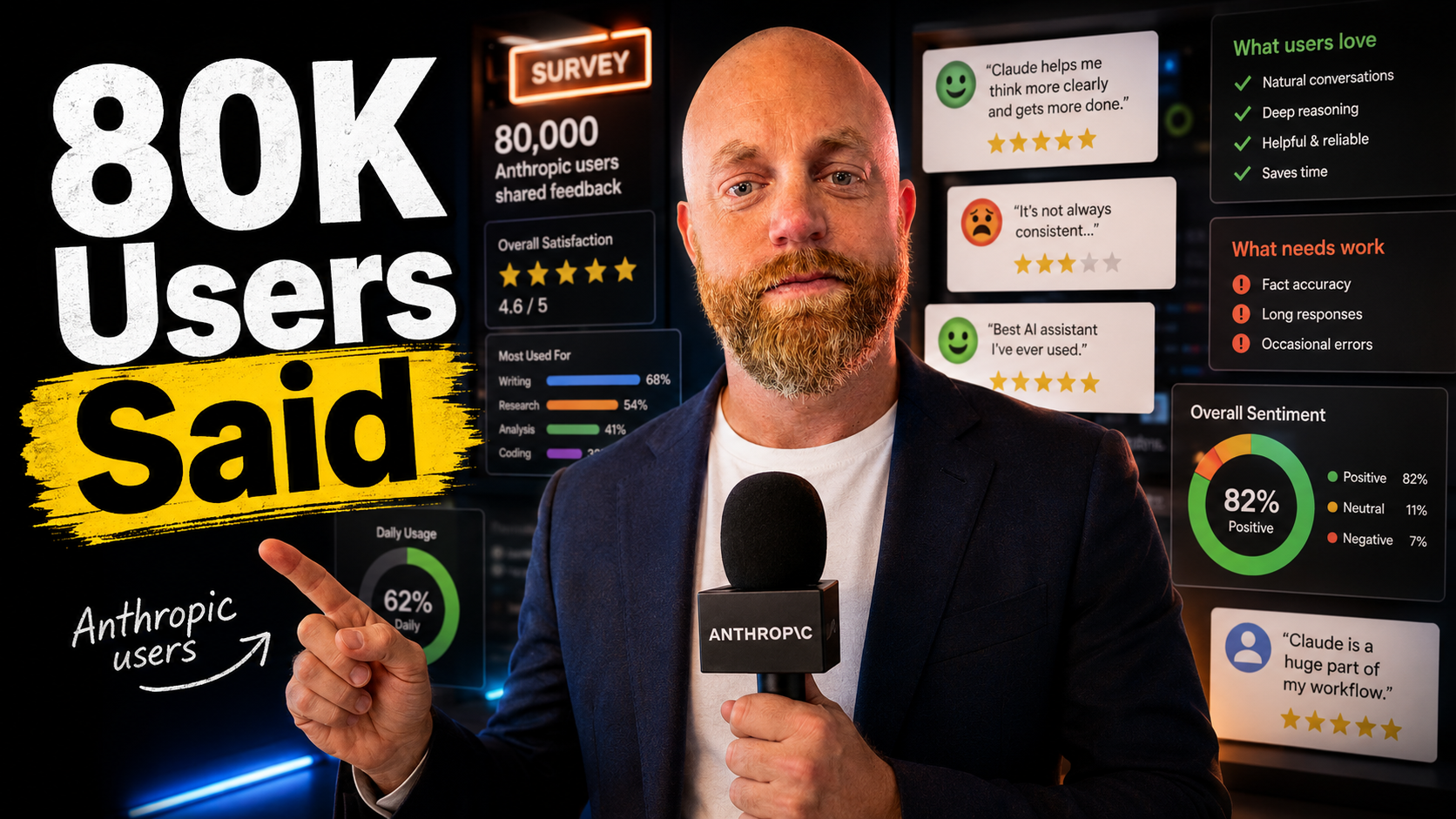
Anthropic's Claude User Study Shows the Tension Everyone Feels
The most honest thing in Anthropic's Claude user study is the contradiction.
People like AI. They also worry about it.
Not in two separate groups. Often in the same person.
That feels exactly right.
The Useful Part Is Also the Risk
The features people value most are the ones that create the most anxiety.
AI makes you faster. It can also make you dependent.
It helps you think through a problem. It can also tempt you to stop thinking first.
It gives individuals access to capabilities that used to require a team. It can also make whole categories of work feel less secure.
That is not a messaging problem. That is the actual tradeoff.
Why Region Changes the Story
The study's regional split makes sense.
In places where access to expertise is expensive or uneven, AI looks like leverage. It gives people a way to write, code, analyze, and learn without needing the old gatekeepers.
In places where knowledge work is already the economic advantage, AI can look more like erosion. People see the productivity boost and immediately ask what happens to the job market.
Both reactions are rational.
Same tool. Different starting point.
What Builders Should Take From This
The adoption problem is not only capability.
The models are useful enough for a lot of real work already. The bigger issue is trust.
Can the tool explain its limits?
Can the user tell when it is guessing?
Does the workflow keep a person in the loop at the right moment?
Does the product make dependency easier or harder?
Those are design questions, not benchmark questions.
The Part I Keep Coming Back To
I notice the same tension in my own workflow.
There are tasks Claude handles in minutes that used to take me an hour. That is real value.
There are also moments where I catch myself asking before I have tried to reason through it. That is the part to watch.
The answer is not to avoid the tool. The answer is to build habits around it.
Use AI for leverage. Keep your own judgment active. Notice when convenience starts replacing the muscle you still need.
That is not anti-AI. That is how you use the thing without slowly outsourcing your own taste.
Anthropic publishing that tension is a good sign. The companies that earn trust here will be the ones honest enough to admit that the best features also need the strongest boundaries.