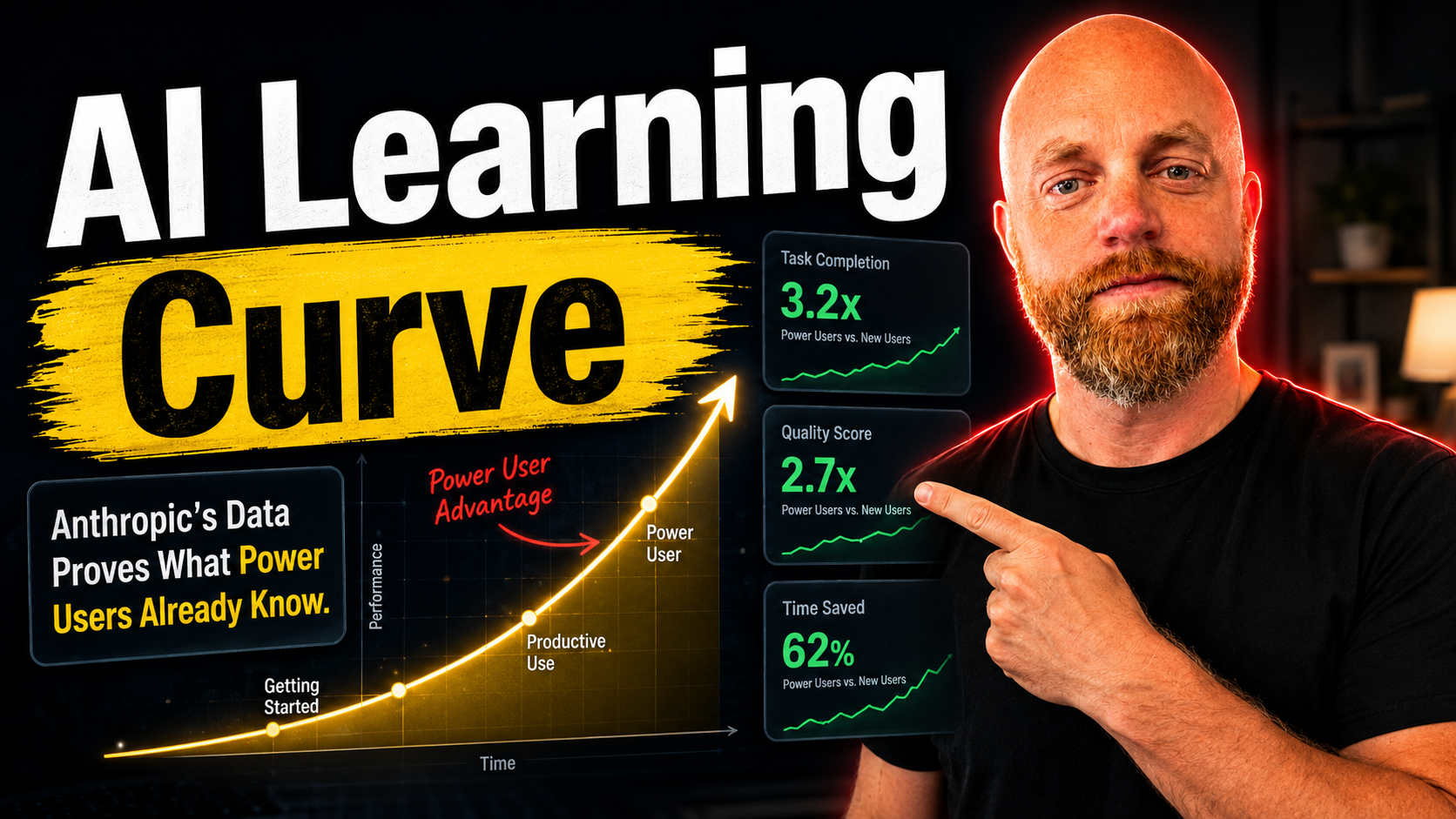
AI Has a Learning Curve, and Anthropic Measured It
The people who use AI well are not just "better at prompts."
They have reps.
That is the useful part of Anthropic's Economic Index work. It puts numbers behind something power users already feel: AI has a learning curve.
Experience Changes the Conversation
New users tend to treat Claude like a search box or command line.
Ask once. Get answer. Move on.
Experienced users collaborate. They add context, correct direction, ask for a second pass, narrow the task, and choose the right model for the job.
That sounds small until you watch the output difference.
The same model feels much smarter when the user knows how to work with it.
What Power Users Do Differently
They bring context.
They do not ask for "a marketing plan." They explain the customer, offer, constraint, channel, deadline, and what has already failed.
They iterate.
The first answer is not treated as final. It is material.
They choose the right surface.
Claude Code for code. Long-context chat for documents. Smaller models for cheap formatting and extraction. Stronger models when the reasoning actually matters.
They build reusable context.
Repo maps, style guides, project notes, saved prompts, example outputs. Boring stuff that makes every future session better.
Why This Matters
The gap compounds.
If one person uses AI every day for actual work and another person keeps "meaning to try it," the difference is not just time saved this week. It is skill gained.
The first person learns what to delegate, how to phrase tasks, when to distrust the output, and how to recover when the model gets weird.
The second person is still waiting for the tool to become obvious.
It will not become obvious from the sidelines.
How to Start Without Making It a Whole Thing
Pick one repeated workflow.
Meeting notes. Email drafts. Code review. Proposal outlines. Weekly reporting. Something you already do often enough to notice improvement.
Use Claude for that workflow for a month.
Not as a demo. As the process.
You will be clumsy at first. Good. That is the learning curve. The point is to get through the awkward stage while the stakes are manageable.
The Door Is Still Open
This is not a "too late" argument.
It is a "start getting reps" argument.
The tools are changing quickly, but the core skill is stable: knowing how to give context, evaluate output, and turn a model response into usable work.
That skill will matter more, not less.
If AI belongs anywhere in your workflow, the best time to start learning the shape of it is before the gap feels urgent.