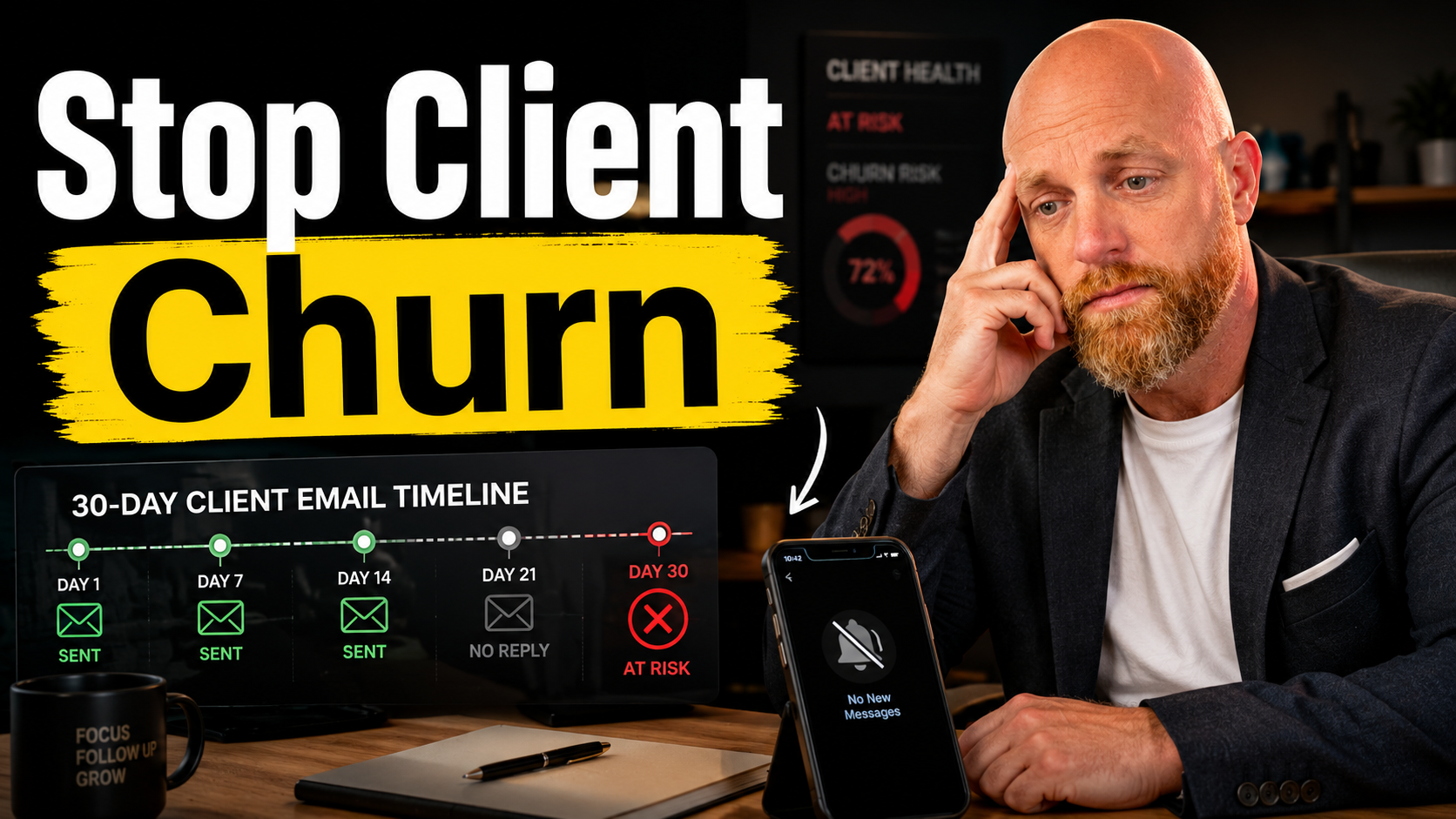
Your Client's Silent Week Just Killed Your Retention Rate (The 30-Day Email Sequence That Fixes It)
You closed the deal. Contract signed. Check deposited.
Then silence.
Three days pass. Your new client starts questioning their decision. By day seven, they're googling your competitors. According to Moxo's 2026 B2B Retention Report, 43% of client churn happens in the first 90 days, with 45% of organizations identifying onboarding as a weak point.
That silence between signature and first deliverable is where money goes to die. Here's how to fill it with confidence instead.
The Numbers Don't Lie About Email Onboarding
Onboarding emails reach 60-85% open rates, far above standard marketing benchmarks. Below 40% on Day 7 may signal a deliverability or subject line problem. These aren't promotional blasts competing with Netflix newsletters. They're the emails your clients actually want to read.
Strong onboarding drives 3 times more conversions, 65% higher renewals, and 35% fewer support tickets, directly impacting revenue and customer lifetime value. Translation: the work you put into onboarding pays dividends for months.
Companies using automated onboarding workflows reduce churn by 25%. Automation + AI reduces friction, speeds up onboarding, and cuts support tickets. The key word is automated. Manual follow-up dies in your inbox.
The Tools That Actually Work (With Real Pricing)
Mailchimp Mailchimp has a free plan that's limited to 250 contacts and 500 mail sends per month. Paid plans start at $13/month for additional features like 10x more contacts and 4 marketing automation flows. Perfect for service businesses under 1,000 clients. The automation builder is simple enough for your team to set up without hiring developers.
ActiveCampaign ActiveCampaign pricing starts at $15/month and scales based on contact count and automation needs. ActiveCampaign Plus offers the best mid-market value at $49/month with CRM, lead scoring, and advanced automation included. This is where you go when Mailchimp feels too basic. Marketing teams using ActiveCampaign save an average of 10 hours weekly across tasks like campaign building, content creation, and lead follow-up.
HubSpot HubSpot's Starter plan ($20/month) has no workflows or email sequences, so most teams need Professional at $890/month. Add the mandatory $3,000 onboarding fee and forced annual billing, and year-one spend exceeds $13,000 before contact overages. Only makes sense if you're already married to their CRM ecosystem.
The 30-Day Email Sequence That Stops Churn
Day 0: The Instant Welcome Day 0: Send a welcome email within minutes of contract signing. This email lands while they're still in signing mode. Include exactly what happens next, when they'll hear from you again, and one small thing they can do today.
Days 1-3: The Foundation Day 1 email explains the first week. Day 3 asks for the assets you need. No fluff, just the next concrete step. When a client signs and then hears nothing for three days, they start questioning whether they made the right call. A structured email sequence replaces that silence with a clear narrative.
Week 1: The First Win Products that deliver a "quick win" during onboarding retain 80% more users, and video is one of the most effective formats for guiding users to that first success moment. This isn't about completing your entire scope. It's about showing them something tangible by day 7.
Days 14-21: The Progress Check Mid-month emails focus on what's working and what's next. Include one metric, one insight, one adjustment. Keep it under three sentences per point.
Day 30: The Review Time-to-first-value (TTFV): The gap between contract signing and the client's first measurable outcome. Amplitude's retention research identifies TTFV as the single strongest predictor of long-term retention. This email summarizes the first 30 days and sets up month two. Include specific outcomes, not just activities.
The Setup That Actually Scales
Here's where most businesses fail: they build the sequence once and never touch it again. Without analytics, you can't improve. Track these four metrics monthly:
- Email open rates by sequence position
- Response rates to asset requests
- Time from welcome to first deliverable
- 90-day client retention rates
Onboarding completion rate: Did the client finish every step including kickoff call, asset submission, and approval? High completion rates correlate directly with lower early churn.
The tools handle the automation. You handle the iteration.
Where Most Sequences Break Down
I've seen hundreds of onboarding sequences. The failures always happen in the same three places:
- Generic messaging. "Welcome to our family" emails that could come from anyone.
- Vague next steps. "We'll be in touch soon" instead of "Expect the wireframes by Thursday."
- No feedback loop. Building the sequence once and assuming it works forever.
Personalized onboarding paths increase completion rates by 35%, and segment-based messaging drives up to 3 times higher engagement in email nurture sequences. The fix isn't more emails. It's better targeting.
The 90-Day Reality Check
According to Bain & Company research cited by Onramp, a 5% increase in customer retention produces more than a 25% increase in profits. That math works because retained clients buy more, refer others, and cost less to serve.
44% of cancellations happen within the first 90 days of subscription and most churn occurs within the first 60 days. Your onboarding sequence is competing against that timeline.
The businesses that survive 2026 will be the ones that turn new client acquisition into new client activation. Email automation isn't about sending more messages. It's about sending the right message at the moment your client needs to hear it.
Start with day zero. Everything else follows from there.
Have a different take on client onboarding sequences, or want to share what's working in your business? Drop me a line and let's compare notes.