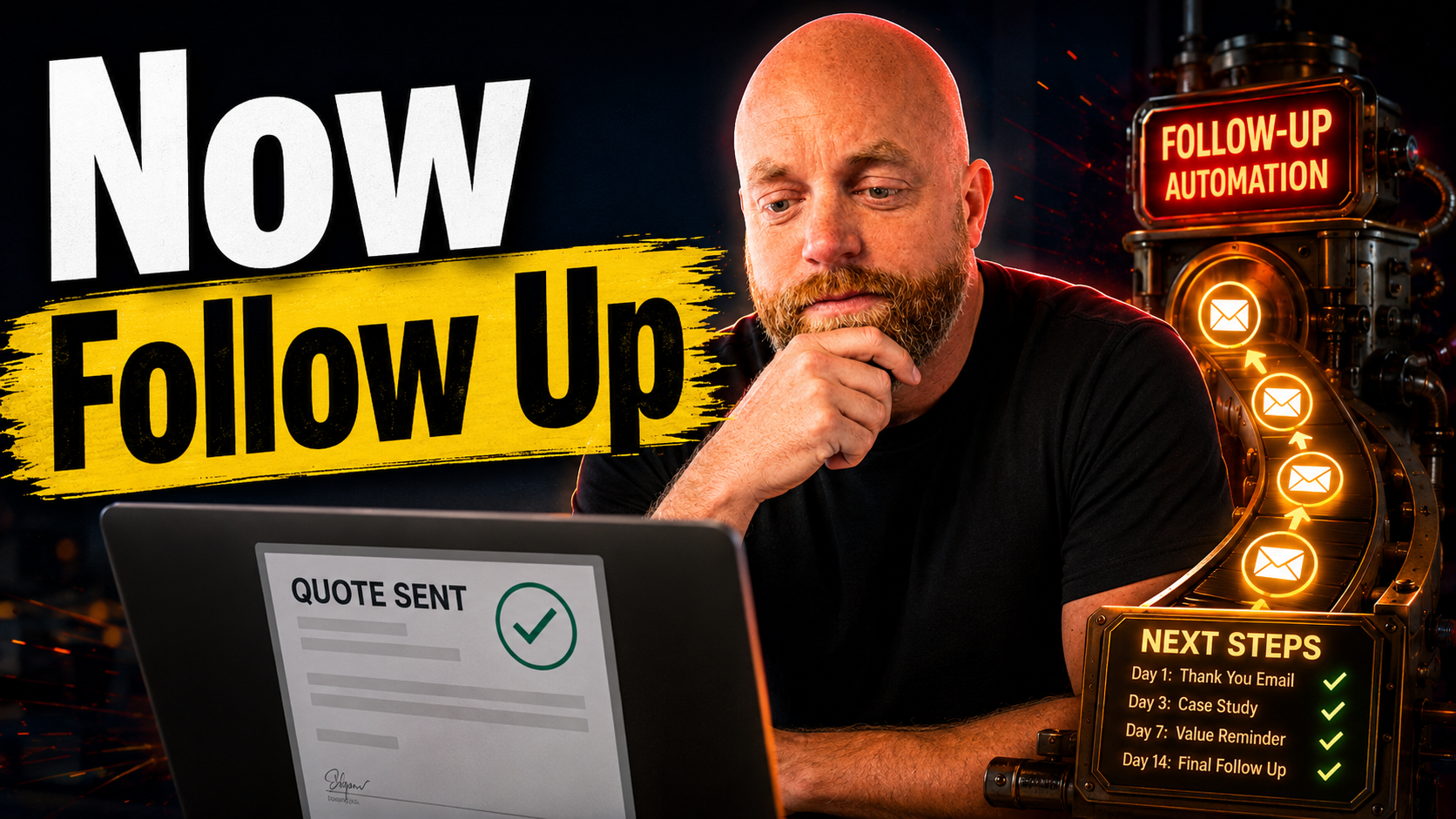
You Sent the Quote. Now What?
You click send. The quote's out there. Now you wait.
Most small business owners send that quote and move on. Maybe they follow up once if they're feeling ambitious. Then they wonder why their quote follow-up conversion rate sits at 15% while their competitor down the street is closing 35% of theirs.
The difference isn't the quality of work or the pricing. It's what happens after you hit send.
What Quote Follow-Up Actually Means
Quote follow-up is the sequence of messages you send after a prospect receives your quote. A good quote follow-up email sequence reminds them you exist, answers the objections they haven't voiced yet, and gives them a reason to reply. It's the single highest-leverage activity in a service business, and almost nobody does it properly.
The rest of this post covers the numbers behind quote follow-up, the four-email sequence that actually works, and the tools you can wire it into. If you want the shorter version with a walkthrough of the exact automation, I wrote a companion piece: three follow-up emails that turned quotes into revenue.
The Numbers That Should Keep You Up at Night
A study by Marketing Growth Hub found that 80% of potential opportunities are lost simply due to lack of follow-up. Here's what that actually costs you.
If you send 100 quotes per year at $3,000 average job value with a 15% conversion rate, you're doing $45,000 in revenue. With proper quote follow-up sequences, that same 100 quotes at 35% conversion becomes $105,000. That's $60,000 more revenue for the same quotes, same quality, just better follow-up.
The time investment? About 10 minutes per quote to customize and send automated emails over 3-4 weeks. That's 16.5 hours per year for an extra $60,000. Show me another business activity that pays $3,636 per hour.
The Four-Email Quote Follow-Up Sequence That Actually Works
Here's the follow-up sequence that took one contractor from 15% to 35% conversion rate:
Email 1 (Immediately): "Quote attached - quick question" Confirm receipt and ask one qualifying question about their timeline or specific needs. This isn't just confirmation. It's engagement.
Email 2 (3 days later): "Three things that might help" Address the three most common objections or questions you get about quotes in your industry. Don't wait for them to ask. Preemptively solve their concerns.
Email 3 (7 days later): "How this played out for [similar client]" Send a brief case study of a similar project. Include the challenge, your solution, and the result. Social proof moves people from "maybe" to "yes."
Email 4 (14 days later): "Final check - moving to our wait list" Create gentle urgency. You're not being pushy. You're managing your schedule. This often gets the fastest response.
Why Automated Quote Follow-Up Beats Manual Every Time
You're busy running your business. You don't have time to remember which quotes need follow-ups, craft personalized messages, or track who opened what. Automated quote follow-up saves your sanity and your revenue.
The best quote management systems don't just store your quotes. They trigger follow-up sequences automatically, track engagement, and tell you exactly when to pick up the phone.
Any of these three tools can run the four-email quote follow-up sequence. Pick whichever fits your stack.
CRM with behavior triggers. If you want follow-ups that branch based on what prospects actually do — opens, clicks, downloads — a tool like ActiveCampaign handles it. Connect email behavior directly to sales actions. Good fit if you're already running email marketing.
Simple linear sequences. If your quote process is straightforward, a tool like Mailchimp with Customer Journeys will do the job. Four-email sequence, triggered on a "quote sent" tag. No branching, no complexity. Cheapest option.
All-in-one small business CRM. Something like Keap combines quote delivery, electronic signatures, and the follow-up sequences in one place. Move a lead to "quote sent" and the sequence fires automatically. Best if you want everything under one roof.
Whichever you pick, the email sequence is what matters, not the logo on the dashboard.
The One Failure Mode That Kills Everything
The biggest mistake isn't sending bad follow-ups. It's letting the system go stale. You set up the automation, it works great for six months, then you change your quote process or pricing structure and forget to update the sequences.
Stale automation is worse than no automation. It sends outdated pricing, references services you no longer offer, or uses case studies from projects that are no longer relevant.
Set a quarterly reminder to review and update your sequences. It's 30 minutes that protects thousands in revenue.
Making Quote Follow-Up Work in Your Business
Start simple. Pick one tool and set up one four-email sequence. Test it on your next 10 quotes. Track which emails get opened, which get responses, and which lead to sales.
The system works whether you're sending 5 quotes a month or 50. The automation scales. Your manual follow-up doesn't.
If you're retrofitting an existing process, export your current quotes and set up a sequence for the ones still in progress. Don't wait for new quotes to start seeing results.
The difference between 15% and 35% conversion isn't luck. It's systems. You've already done the hard work of creating the quote. The follow-up is what turns that work into revenue.
Want to compare notes on what's working in your follow-up process or share what you've tried? Drop me a line.