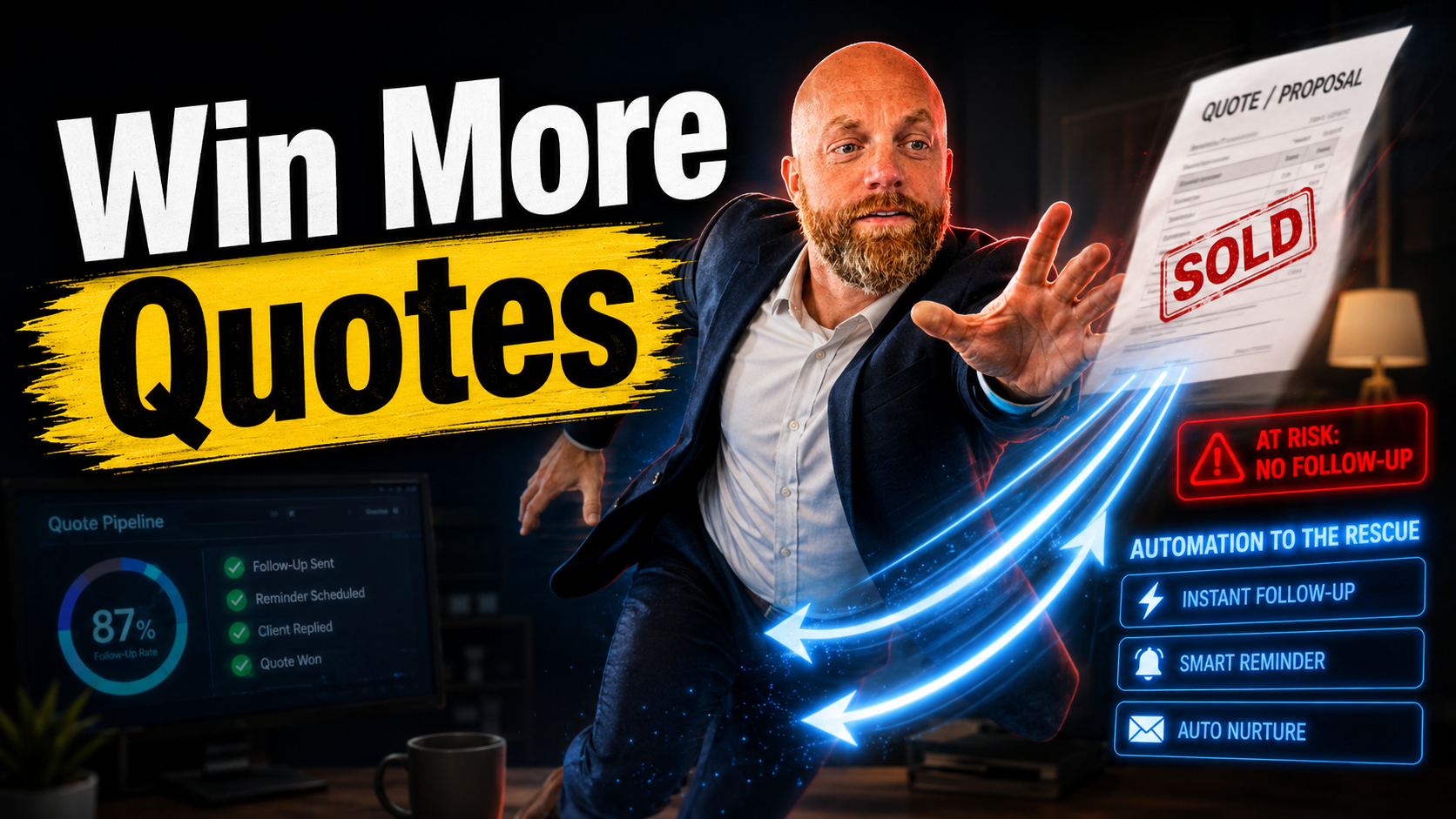
Stop Losing Jobs You Already Won: The Quote Follow-Up Automation That Pays for Itself
The $5,000 job walked out your door last Tuesday. You sent the quote Wednesday morning. It's Friday now and you meant to follow up, but a pipe burst on the Henderson job and that took all day.
By Monday, your potential customer has three more quotes in their inbox and yours feels old.
Only 2% of sales are made during the first point of contact. That means if you don't follow up, even with a simple follow-up email, you're missing out on potentially 98% of your sales.
The result is that most contractors follow up on maybe 20–30% of their sent quotes. The other 70–80% get no follow-up at all. That's jobs left on the table every single week.
The Real Cost of Inconsistent Follow-Up
I've worked with hundreds of small businesses. The pattern is always the same. They blame slow months on the economy, competition, or pricing. But when we pull their quote data, the problem is obvious.
They're not losing jobs to competitors. They're losing them to silence.
Email marketing remains the undisputed king of digital ROI, generating an average of $42 to $45 for every dollar spent. But here's what most small business owners miss: the money isn't in the first email. 50% of all sales happen after the 5th contact, but most reps give up after just 2. 55% of replies to cold email campaigns come from a follow-up email.
Your customer isn't ignoring you. They're busy, distracted, or comparing options. Contractors see 40 to 60% higher close rates when they automate quote follow ups. Most lose revenue from inconsistent follow-up, not overpricing.
How Auto-Follow-Up Actually Works
The best systems trigger the moment you send a quote. No manual lists. No reminder tasks. No hoping you remember next Thursday.
Here's a sequence that works:
Day 1 (3 hours after quote): A text message. "Hi [Name], just sent your quote over. Let me know if you have any questions - [Your Name]"
Day 3: Email follow-up. Check in without being pushy. Ask if they need clarification on anything.
Day 7: Value-add follow-up. Send a case study, photo of similar work, or customer testimonial.
Day 14: Final follow-up. "I know you're probably still comparing options. If you have any questions before making your decision, give me a call."
Results vary by trade and market, but most contractors see a 15–30% improvement in quote conversion rate after implementing automated follow-up.
Tools That Actually Work for Small Business
ActiveCampaign remains the most powerful option for behavior-triggered sequences. The Starter plan at $15/month (1,000 contacts) includes basic automations; the Plus plan at $49/month unlocks the full automation suite including CRM features, lead scoring, and site tracking.
For contractors specifically, QuoteIQ builds this directly into their estimating workflow. Email & Text Automation Send automated follow-ups, discounts, & more. QuoteIQ offers five pricing tiers with no per-user fees on any plan. Essentials is $29.99/month for solo contractors (1 user, 500 IQ Credits).
Brevo offers the best free option. Sender is a feature-rich email and SMS marketing platform built for small and growing businesses. It offers one of the most generous free plans in the industry: 2,500 subscribers and 15,000 emails per month with full automation access.
The key is picking something you'll actually use. A simple system that runs beats a sophisticated one that sits idle.
What Good Follow-Up Actually Says
Most business owners worry about seeming pushy. But here's what your follow-up really communicates:
- You're organized and professional
- You want their business
- You won't disappear after the sale
- You're still available if they have questions
According to MTD Sales Training, 80% of successful sales require FIVE follow-up contacts before closing, yet most service providers give up after just one or two attempts.
Your competitors are giving up after attempt number two. You're winning the job on attempt number four.
Setup That Takes 30 Minutes, Not 30 Hours
The biggest mistake I see is overcomplicating the setup. Start simple:
- Pick your tool. ActiveCampaign for power users, Brevo for budget, QuoteIQ if you're a contractor.
- Write four emails. Use the timing above. Keep them short and helpful.
- Connect your quote process. Most tools integrate with whatever you're using to send estimates.
- Test it on yourself first. Send yourself through the sequence to catch any weird formatting or timing.
Most contractors see improvement within the first month, with significant gains appearing after 90 days of consistent automated follow-up.
The businesses that see the best results treat this like any other business system. They measure it, refine it, and improve it over time.
The One Gotcha That Kills Systems
If your hourly value is $100, that is a $2,000 monthly cost. Affordable email automation platforms, often costing less than $50 a month, reclaim that time immediately. Furthermore, automated emails generate 320% more revenue than non-automated ones.
But here's the gotcha: automated doesn't mean impersonal. The systems that work best feel like they came from you, not a robot.
Use the customer's name. Reference their specific project. Mention details from your conversation. The automation handles the timing and delivery. You handle making it feel human.
Bad automation feels like spam. Good automation feels like you're just really good at follow-up.
If you send 50 quotes a month and convert 10 of them manually, automating your follow-up could get you to 15 conversions with the same effort. That's 5 extra jobs without finding a single new customer.
The math works at any scale. The question is whether you'll set it up this week or keep hoping you remember to follow up next time.
Questions about setting up your own quote follow-up sequence? Let's talk about what works for your specific business.