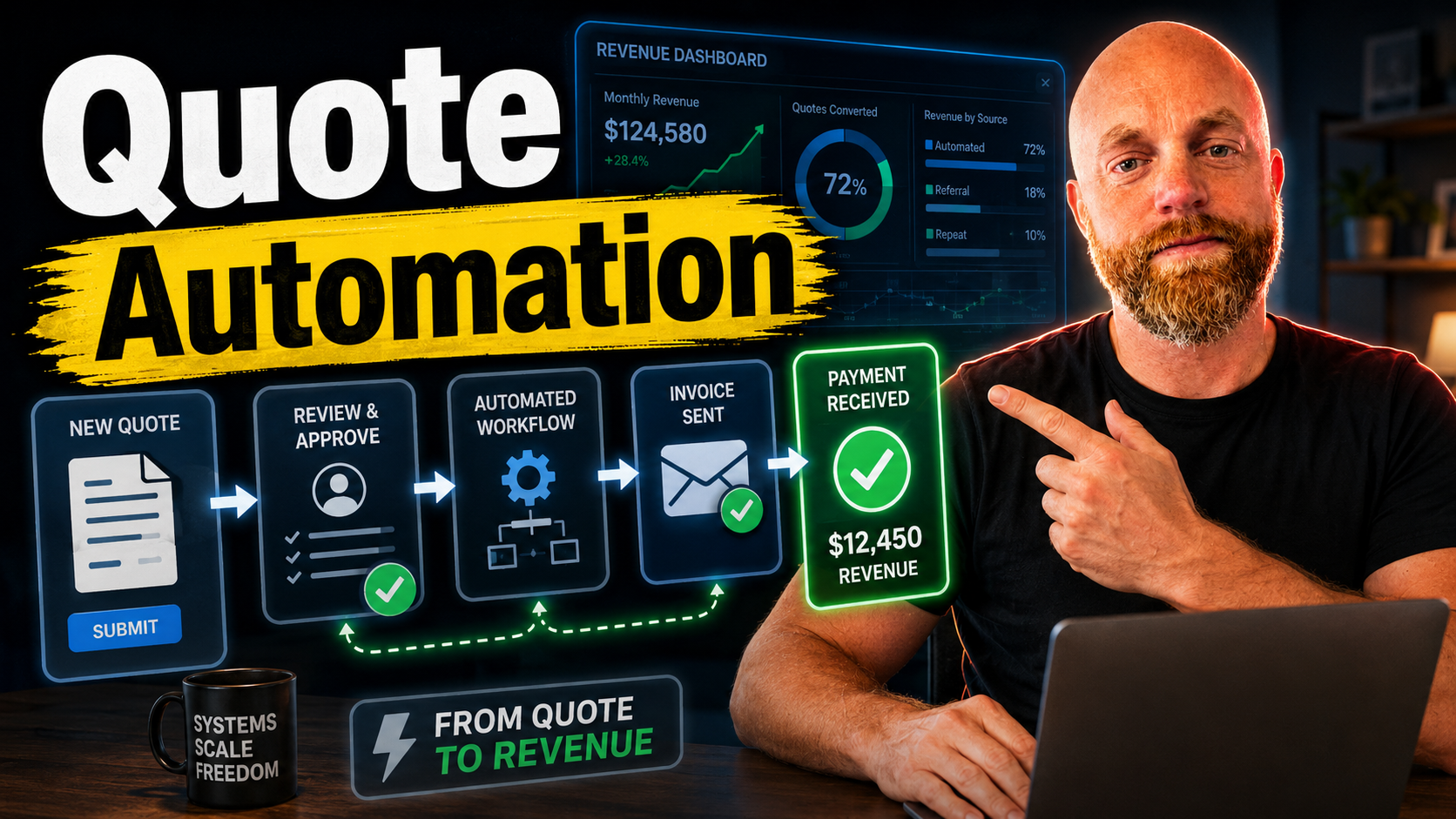
Your Quote Just Became Automated Revenue: How One Follow-Up Sequence Doubled Conversion Rates
> cat ./blog/automated-quote-follow-up-doubled-conversion-rates

Your Quote Just Became Automated Revenue: How One Follow-Up Sequence Doubled Conversion Rates

Apr 10, 2026/6 min read
#email automation#quote conversion#small business sales#follow-up sequences

I'm closing maybe 15%. Dave and I do similar work. Similar prices. Similar quality. "Follow-up emails," he says. My conversion rate went from 15% to 35% almost immediately.

That conversation at the builders merchant changed everything. Not because Dave revealed some secret strategy, but because he'd automated something most small business owners do manually or not at all. Following up on quotes.

A study by Marketing Donut revealed that 80% of potential opportunities are lost without trace simply due to lack of follow-up. Your quote isn't the end of the sales process. It's the beginning of a conversation that most businesses never have.

The Numbers That Made Me Rethink Everything

That 20% difference on 100 quotes a year at £5,000 average? That's £100,000 in revenue I'd been leaving on the table. Same 100 quotes per year. £105,000 in revenue. Difference? £60,000 per year.

But here's what made it real for me. About ten minutes per quote to customise and send the emails over three to four weeks. That's 16.5 hours per year. £60,000 revenue divided by 16.5 hours equals £3,636 per hour.

Show me another business activity that pays £3,636 per hour.

Why Quotes Die in Email Silence

About half the time, they need to check with their wife, or husband, or business partner. It's not a solo decision. Maybe 30% of the time, they need to see if they can actually afford this right now. Another 15% or so want to get one more quote to compare.

Your potential customers aren't ignoring your quote because they don't want the work. They're dealing with the reality of making a business decision. The optimal window for a first quotation follow-up is 2-3 business days after sending the proposal. This gives the prospect enough time to read it without letting momentum die.

Following up with web leads within one minute can boost your chances of conversion by a whopping 391%. This stat highlights just how crucial timely follow-ups are in the sales process.

The Three-Email Sequence That Works

Sending 1 to 3 emails in sequence produces a 9 percent reply rate. Sending 4 to 7 emails in sequence produces a 27 percent reply rate — three times higher. But for quotes, less is more strategic.

Email One: The Check-In (Day 3)

Subject: "Did you get my quote?"

"Hi [Name], just wanted to make sure you received the quote I sent on Tuesday. I know these decisions take time, but wanted to check if you had any questions about the scope or pricing. Happy to jump on a quick call if that's easier."

Our general recommendation for the first follow-up after the quote is two days, and then again at six days if you haven't gotten a response.

Email Two: The Value Add (Day 7)

Subject: "One thing I forgot to mention..."

"Hi [Name], I've been thinking about your project since we spoke. One thing that might help - we recently finished a similar job for [relevant example] and learned that [specific insight relevant to their situation]. This could save you about [specific benefit] on your project. Still happy to discuss if you have questions."

Email Three: The Soft Close (Day 14)

Subject: "Last check before I update my schedule"

"Hi [Name], I haven't heard back about the quote, which usually means the timing isn't quite right. No problem at all - these decisions can't be rushed. I'm updating my schedule for the next few weeks, so if this is something you want to move forward with, let me know by Friday. Otherwise, I'll follow up in a few months to see if anything's changed."

The Automation Tools That Make This Effortless

MailerLite — Best free email automation tool for small business. At $9/month, I expected limitations. Instead, I got unlimited emails, a visual automation builder, A/B testing, landing pages, and 18 pre-built workflow templates. Moosend doesn't.

MailerLite: The Free Option That Actually Works

The Free plan is perfect for those just starting out. It offers the essential features, including sending up to 500 subscribers, campaign creation, automations, a website, and the ability to create 10 landing pages.

The Growing Business plan starts at $9 monthly for up to 1,000 subscribers, then scales at roughly $0.0275 per additional subscriber. For 2026, the Growing Business plan costs $0.0275 per subscriber monthly for lists under 10,000 subscribers.

ActiveCampaign: When You Need More Power

These users can actually earn more from automation than they spend. ActiveCampaign is not overpriced for businesses that rely heavily on automation.

ActiveCampaign's pricing begins at 15 dollars per month for the Starter plan with up to 1,000 contacts on annual billing. But the real power comes at the Plus level where you get the CRM integration.

We're talking about segmentation, dynamic content, site tracking, lead scoring – the full gamut of marketing automation. It even has an inbuilt CRM, allowing you to link up your sales and marketing data, and set up automations for sales follow-ups.

Setting Up Your First Automated Follow-Up

  1. Choose Your Tool: Start with MailerLite's free plan if you have fewer than 500 quotes per year. Upgrade to ActiveCampaign if you need CRM features.

  2. Build Your Sequence: Create three emails with 3, 7, and 14-day delays. Each email should add new value, not just repeat your ask.

  3. Set Your Trigger: Import your quote recipients manually or connect your quoting software via Zapier.

  4. Track What Matters: Watch reply rates, not just opens. Track inbox placement, complaint rates, and replies — not just opens. A 30% open rate is meaningless if most of those emails land in spam.

The One Failure Mode That Kills Everything

Sending 4+ emails in a sequence more than triples your unsubscribe and spam complaint rates. If you're hitting unsubscribe landmines by email #4, you're not following up — you're just getting filtered out. It's hard to admit, but sending several emails in a row increases the likelihood of negative consequences.

Three emails. No more. No matter how strong your domain, stick to 3 total emails per prospect in a campaign (initial + 2 follow-ups). Beyond that, engagement falls and spam complaints rise.

Beyond the Three-Email Sequence

Day thirty to forty-five, then monthly after that. Stay top of mind for when timing is right. Maybe 2-5% over time, but this adds up. Six months later, they're ready, and you're the only one still in touch.

Move non-responders to a monthly newsletter. Share project updates, seasonal tips, industry insights. Keep it valuable, not salesy. Another powerful motivator is social proof. If your follow up includes an example of how someone else benefited from what you're offering, it becomes much more persuasive.

This isn't about pestering people who said no. It's about staying connected with people who said "not yet." There's a massive difference, and your bank account will feel it.

Automated quote follow-up isn't just about closing more deals. It's about turning the time you've already invested in quotes into predictable revenue without adding hours to your workday. Set it up once, let it run, and watch your conversion rates climb from wherever they are now to something that actually pays the bills.

If you want a follow-up sequence built and wired into your quoting tool without doing any of this yourself, that's what I do. Tell me what quoting tool you use and I'll tell you what the setup looks like.